Tel:
Tel: E-Mail:
 English
 Chinese
 한국어
한국어
 Español




News
Why Angle Seat Valves for Automation?
| Requirement | How Angle Seat Valve Meets It |
|---|---|
| Fast actuation | 20–50ms response time |
| High cycle life | 3–5 million cycles |
| PLC integration | Simple solenoid valve control |
| Visual feedback | Position indicator standard |
Typical uses: Filling machines, packaging lines, CIP systems, chemical dosing.
Key Components for Automation
| Component | Function |
|---|---|
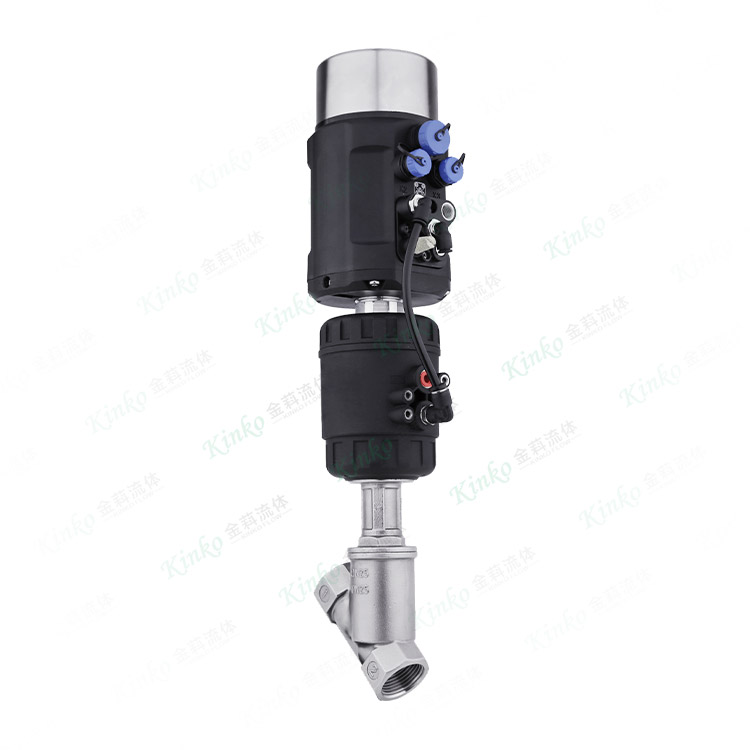
| Solenoid valve | Converts PLC signal to air pressure |
| Speed controller | Adjusts opening/closing speed |
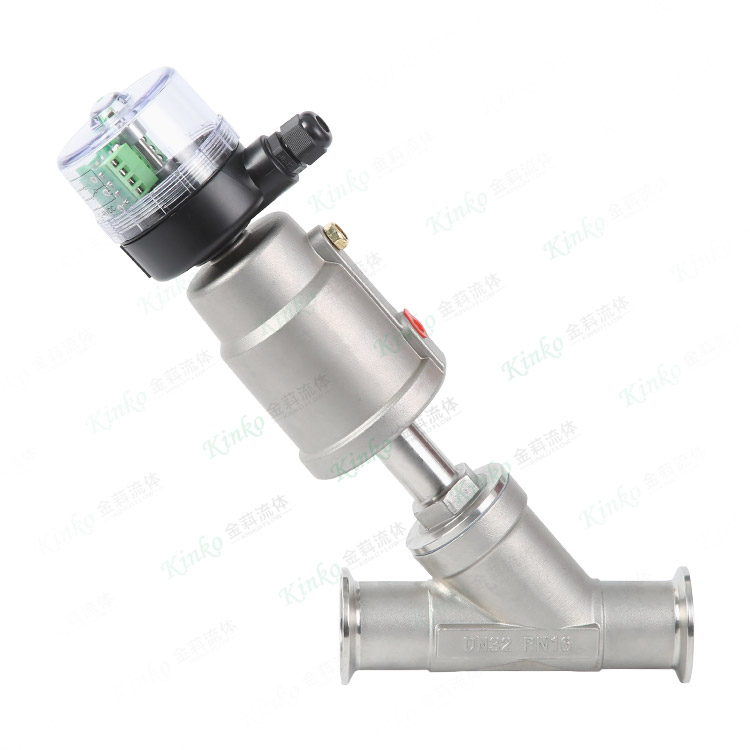
| Position indicator | Visual confirmation (open/closed) |
| Limit switches (optional) | Electronic feedback to PLC |
Solenoid Valve Selection
| Feature | Recommendation |
|---|---|
| Voltage | 24V DC (most common) |
| Power consumption | 2–4 watts |
| Function | 3/2 way for single-acting, 5/2 for double-acting |
| Manual override | Yes (for testing) |
| IP rating | IP65 (washdown areas) |
Response Times
| Action | Time |
|---|---|
| Solenoid energizing | 10–20ms |
| Actuator stroke | 20–50ms |
| Total open/close | 30–70ms |
Result: Up to 15–20 cycles per second (with small valves).
PLC Integration Wiring
Simple setup:
PLC digital output → Solenoid valve coil
Solenoid valve → Angle seat actuator (air tubing)
Position feedback (optional) → PLC digital input
Control methods:
| Method | Signal | Best For |
|---|---|---|
| Direct on/off | 24V DC to solenoid | Simple filling, isolation |
| PWM (pulse width modulation) | Rapid pulses | Precise dosing |
| Bus control (IO-Link, AS-i) | Network signal | Large automated systems |
Speed Control for Automation
Add flow control valves (speed controllers) to actuator exhaust ports.
| Application | Recommended Close Time |
|---|---|
| Water / low viscosity | 0.5–1 second |
| Viscous media | 1–2 seconds |
| Steam | 0.3–0.5 seconds (fast to prevent condensation) |
Too fast: Water hammer (damages pipes and seats)
Too slow: Reduced production speed
Cycle Life in Automated Lines
| Operating Condition | Expected Cycles |
|---|---|
| Clean air / water | 3–5 million |
| 5000 cycles/day | 2–3 years of life |
| 20,000 cycles/day | 6–12 months of life |
Tip: For extremely high cycle rates, specify PTFE + carbon-filled seals.
Normally Closed vs Normally Open for Automation
| Type | Air to Open? | Fail Position | Best For |
|---|---|---|---|
| Normally Closed (NC) | Yes | Closed | Most automated lines (safety) |
| Normally Open (NO) | Yes (to close) | Open | Venting, cooling, purge |
Recommendation: NC is standard for 90% of automated applications.
Optional Feedback for PLC
| Feedback Type | Signal | Use Case |
|---|---|---|
| Mechanical limit switches | Dry contact | Open/closed confirmation |
| Inductive proximity sensors | 24V DC NPN/PNP | High-speed, non-contact |
| Magnetic piston sensor | 24V DC | Position feedback from actuator |
Without feedback: PLC assumes valve changed position (blind control)
With feedback: PLC confirms actual valve position (closed-loop)
Common Automation Problems & Solutions
| Problem | Cause | Solution |
|---|---|---|
| Valve not responding | No pilot air or bad solenoid | Check air supply, replace solenoid coil |
| Slow actuation | Clogged silencer or low pressure | Clean silencer, increase pressure |
| Inconsistent filling volume | Speed controller unstable | Adjust or replace flow control |
| No feedback signal | Sensor misaligned or failed | Reposition or replace sensor |
| Valve cycles but line leaks | Worn PTFE disc | Replace disc seal |
Comparison for Automated Lines
| Feature | Angle Seat Valve | Ball Valve | Solenoid Valve |
|---|---|---|---|
| Response time | 20–50ms | 100–500ms | 10–30ms |
| Max cycles | 3–5 million | 200k | 50 million |
| Best line size | DN10–DN100 | DN15–DN300 | ≤DN10 |
| Pilot air needed | Yes | Yes (if pneumatic) | No |
| Power consumption | Low (solenoid only) | Low | Medium |
Choose angle seat for: DN15–DN50, dirty media, high flow, visual indicator needed.
Choose solenoid for: Very small lines (≤DN10), ultra-high cycling.
Kinko Valves for Automated Lines
| Feature | Specification |
|---|---|
| Body | 316L stainless steel |
| Seal | PTFE + 15% glass fiber |
| Response | 20–50ms |
| Cycle life | 3–5 million |
| Solenoid options | 24V DC, 110V AC, 220V AC |
| Feedback options | Limit switches, proximity sensors |
Ivan (Mobile:+86-18968769287)
WhatsApp:+86-13579991606
Wechat:+86-18968769287
Website:www.kinko-flow.com
ZHEJIANG KINKO FLUID EQUIPMENT CO.,LTD

 info@kinko-flow.com
 +86-133 5611 9006