Tel:
Tel: E-Mail:
 English
 Chinese
 한국어
한국어
 Español




News
What Is a Manual Angle Seat Valve?
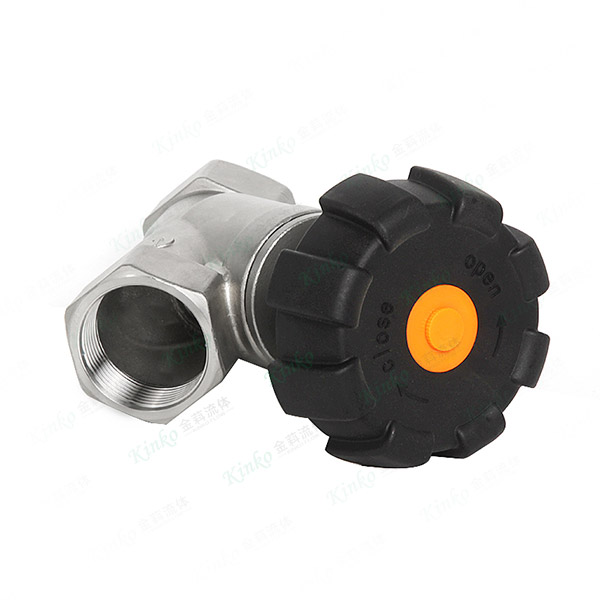
A manual angle seat valve replaces the pneumatic actuator with a handwheel or lever. Turning the handwheel lifts the PTFE disc off the seat, opening the flow path. Releasing closes it via a spring (single-acting) or mechanical screw mechanism.
Key difference from pneumatic version: No compressed air required. All manual operation.
Manual vs Pneumatic: Quick Comparison
| Feature | Manual Angle Seat | Pneumatic Angle Seat |
|---|---|---|
| Actuation | Handwheel or lever | Compressed air |
| Cycle speed | Slow (human-paced) | Fast (20–50ms) |
| Automation ready | No | Yes (solenoid valve) |
| Remote control | No | Yes |
| Initial cost | Lower | Higher |
| Operating cost | Zero (no air) | Compressed air cost |
| Best for | Infrequent operation | High-cycle automation |
Uses of Manual Angle Seat Valves
1. Isolation in Non-Automated Lines
Application: Manual shut-off in small processing lines, bypass lines, or drain lines.
Why angle seat: Lower pressure drop than globe valves. Better throttling than ball valves.
2. Throttling / Flow Regulation
Application: Adjusting flow rate in cooling water, chemical dosing, or steam tracing lines.
Why angle seat: The linear lift design allows smooth, predictable flow control. Ball valves are poor throttling devices.
3. Backup Manual Override
Application: Installed parallel to a pneumatic valve as a manual bypass for maintenance or emergency.
Why angle seat: Same body and connection style. Interchangeable parts.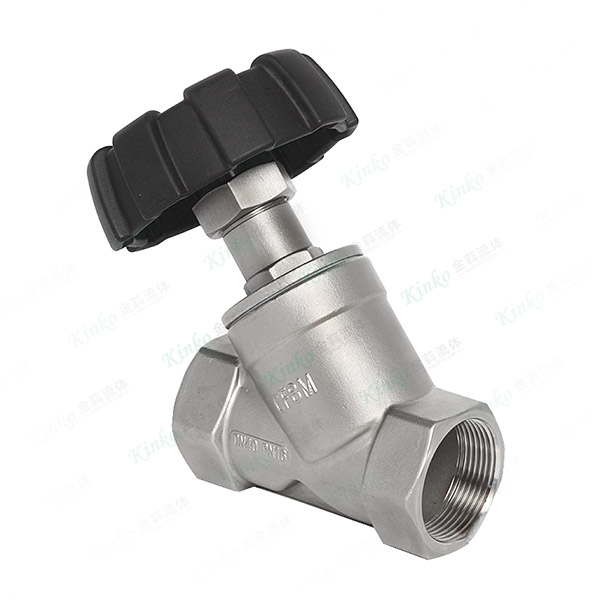
4. Hazardous Areas (No Electricity or Air)
Application: Explosive environments (ATEX Zone 0/1) where pneumatics are too complex or electricity prohibited.
Why angle seat: No electrical or compressed air components. Pure mechanical operation.
5. Remote Locations Without Utilities
Application: Rural water treatment, off-grid oil fields, or temporary installations.
Why angle seat: No need for compressed air, power, or control wiring.
6. Low-Budget Automation Prep
Application: Install manual now, convert to pneumatic later.
Why angle seat: Same valve body accepts a pneumatic actuator. Swap the top, keep the body in the pipe.
Advantages of Manual Angle Seat Valves
Advantage 1: Lower Pressure Drop
| Valve Type | Pressure Drop (Relative) |
|---|---|
| Manual angle seat | Low (angled body) |
| Globe valve | High (tortuous path) |
| Ball valve (full bore) | Very low |
| Gate valve | Very low |
Result: Angle seat beats globe valves significantly. Close to ball valves for flow efficiency.
Advantage 2: Good Throttling Capability
| Valve Type | Throttling Performance |
|---|---|
| Manual angle seat | Good (linear lift) |
| Globe valve | Excellent |
| Ball valve | Poor (quick opening) |
| Gate valve | Poor (seat erosion) |
Result: Angle seat is the second-best throttling valve after globe valves.
Advantage 3: Self-Cleaning Design
Angled body prevents dead zones
PTFE disc wipes seat clean with each close
Ideal for dirty or viscous media
Advantage 4: Bubble-Tight Shut-Off (Class VI)
Same PTFE disc as pneumatic version
Manual closing force achieves zero leakage
Many manual globe and gate valves leak at low closing torque
Advantage 5: Compact Size
| Valve Type (DN25) | Typical Height |
|---|---|
| Manual angle seat | 150–200mm |
| Globe valve | 200–300mm |
| Gate valve | 300–400mm |
Result: Fits in tight spaces.
Advantage 6: Simple Maintenance
Seal replacement without removing valve body from pipe
Same 10–15 minute procedure as pneumatic version
No actuator disassembly required
Comparison: Manual Angle Seat vs Other Manual Valves
| Feature | Angle Seat | Globe | Ball | Gate |
|---|---|---|---|---|
| Pressure drop | Low | High | Very low | Very low |
| Throttling | Good | Excellent | Poor | Poor |
| Shut-off (Class VI) | Yes | Yes (with PTFE seat) | Yes | No (metal seat) |
| Self-cleaning | Yes | No | No | No |
| Compact height | Yes | Medium | Medium | Tall |
| Viscous media | Excellent | Poor | Poor | Fair |
| In-line maintenance | Yes | No | No | No |
| Cost | Moderate | Low | Low | Low |
Conclusion: Manual angle seat valves excel where globe valves have high pressure drop, ball valves have poor throttling, and gate valves leak.
Limitations of Manual Angle Seat Valves
| Limitation | Explanation |
|---|---|
| Higher cost than ball/globe | More complex body casting |
| Limited size range | Typically DN10–DN80 (larger sizes are heavy to operate manually) |
| No visual position indicator | Handwheel position is less obvious than pneumatic indicator |
| Spring return requires force | Normally closed versions need handwheel force to overcome spring |
| Not for very high torque | Manual operator may be insufficient above DN65 |
Normally Closed vs Normally Open Manual Versions
| Type | Handwheel Action | Best For |
|---|---|---|
| Normally Closed (NC) | Turn to open (spring closes when released) | Safety: valve closes if operator releases handwheel |
| Normally Open (NO) | Turn to close (spring opens when released) | Safety: valve opens if operator releases handwheel |
| Locking type | Screw mechanism holds position | Throttling or set-point applications |
Recommendation: Most users choose NC for isolation. The valve stays closed unless manually opened.
Selection Criteria for Manual Angle Seat Valves
| Criterion | What to Check |
|---|---|
| Media | Steam? Chemicals? Viscous? → PTFE seal required |
| Temperature | Above 130°C? → PTFE only |
| Pressure | Above 10 bar? → Ensure handwheel torque is acceptable |
| Size | Above DN50? → Consider gear operator or pneumatic |
| Frequency | More than 10 cycles/day? → Consider pneumatic upgrade |
| Mounting orientation | Handwheel accessible? Valve not upside down? |
Installation Tips for Manual Angle Seat Valves
Same flow direction rule applies: Follow the arrow on the body. Pressure above the seat.
Handwheel orientation: Install so the handwheel faces the operator. 360° rotatable body allows this.
Do not use extension bars: Long extensions increase torque and can damage the stem.
Do not use wrenches on handwheel: Hand-tight only. Over-torquing damages the PTFE disc.
Strainer recommended: Debris damages the seat regardless of actuation type.
Maintenance for Manual Valves
| Component | Maintenance Action | Interval |
|---|---|---|
| PTFE disc | Replace when leakage occurs | Every 1–3 years |
| Stem O-rings | Replace if weeping from top | As needed |
| Handwheel nut | Check tightness | Annually |
| Threaded stem | Clean and lubricate | Annually |
No pilot air maintenance (no actuator to maintain).
When to Choose Manual vs Pneumatic
Choose manual when:
Valve operates less than 5 times per day
No compressed air available
Simple isolation only (no automation)
Budget is very tight
Hazardous area without pneumatics
Choose pneumatic when:
Valve operates hundreds or thousands of times daily
Remote or automated control required
Fast response needed (20–50ms)
Operator not always present
Best of both: Install a pneumatic valve with a manual override (handwheel on top of actuator). Allows automatic control plus emergency manual operation.
Kinko Manual Angle Seat Valves
Kinko offers manual angle seat valves with the same high-quality internals as our pneumatic line:
| Feature | Specification |
|---|---|
| Body | 316L stainless steel (CF8M) |
| Seal | PTFE + 15% glass fiber |
| Size range | DN10 – DN80 (3/8" – 3") |
| Pressure rating | 0–16 bar (0–232 psi) |
| Temperature | -10°C to +180°C |
| Connection | Threaded (BSP/NPT) or Tri-clamp |
| Handwheel | Metal with ergonomic grip |
| Shut-off | Class VI (bubble tight) |
Ivan (Mobile:+86-18968769287)
WhatsApp:+86-13579991606
Wechat:+86-18968769287
Website:www.kinko-flow.com
ZHEJIANG KINKO FLUID EQUIPMENT CO.,LTD

 info@kinko-flow.com
 +86-133 5611 9006