Tel:
Tel: E-Mail:
 English
 Chinese
 한국어
한국어
 Español




News
Types of Leakage in Industrial Valves
| Leakage Type | Location | Cause |
|---|---|---|
| Internal leakage | Across the valve seat (closed position) | Worn seal, debris on seat, incorrect flow direction |
| External leakage (static) | Body-to-actuator connection | Loose union nut, damaged gasket |
| External leakage (dynamic) | Stem / piston rod seal | Worn stem seal, scratched piston rod |
| Pilot air leakage | Pneumatic ports and fittings | Damaged O-rings, loose fittings, missing silencer |
Angle seat valves address all four types through specific design features.
Primary Leakage Prevention Mechanisms
1. Piston-Actuated Stem Design
Unlike traditional globe valves that use a rotating stem, angle seat valves use a linear piston actuator.
How it prevents leakage:
The piston rod moves straight up and down (no rotation)
Straight motion reduces wear on stem seals
No helical scoring or scratches on the rod surface
Single sealing point instead of multiple packing rings
Comparison:
Ball valve: Rotating stem with multiple dynamic seals (more leak paths)
Angle seat valve: Single linear stem seal (fewer leak paths)
2. Self-Lapping PTFE Disc Seal
The PTFE sealing disc is the heart of internal leakage prevention.
How it prevents leakage:
PTFE conforms to the metal seat under pressure
Each closure "laps" (polishes) the sealing surfaces
Self-lapping action improves seal over the first 10,000 cycles
Achieves bubble-tight shut-off (ANSI/FCI 70-2 Class VI)
Class VI standard: Zero visible bubbles during a 1-minute test at full rated pressure.
3. Pressure-Assisted Sealing (Flow Direction)
Angle seat valves are directional. Correct installation uses system pressure to assist sealing.
How it prevents leakage:
Pressure enters above the seat (pushes disc downward)
System pressure increases seating force
Higher pressure = tighter seal
Opposite of globe valves (pressure unseats the disc)
Critical note: Installing backward causes pressure to unseat the disc, resulting in immediate internal leakage.
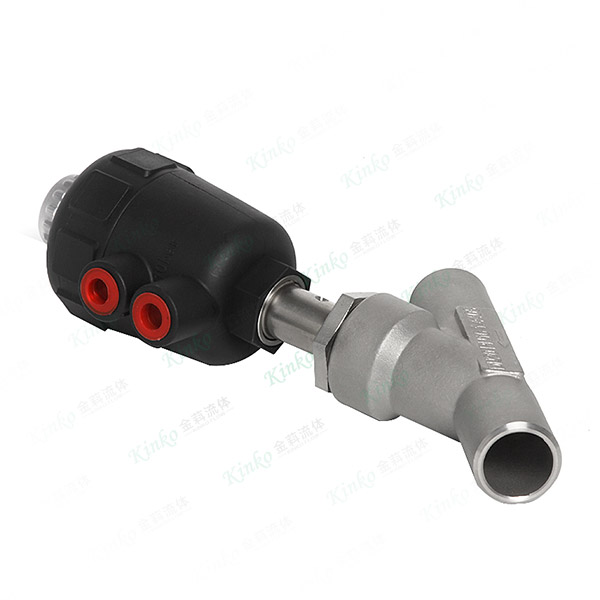
4. Weep Hole for External Leak Detection
A small weep hole between the valve body and actuator provides early warning of seal failure.
How it prevents catastrophic leakage:
If stem seal fails, media escapes through weep hole (not into actuator)
Visible drip alerts maintenance before major failure
Prevents media from entering actuator (which would destroy cylinder and pilot valve)
Allows planned maintenance instead of emergency shutdown
What to look for: Any drip from the weep hole indicates stem seal replacement is needed within 1-2 weeks.
5. Double O-Ring Stem Seals
Quality angle seat valves use redundant stem sealing.
Standard configuration:
Upper O-ring: Primary dynamic seal
Lower O-ring: Backup static seal
Grease-packed cavity between rings for lubrication and contamination barrier
Result: Even if the primary O-ring fails, the backup prevents external leakage until the next scheduled maintenance.
6. Union Nut Connection (Body to Actuator)
The threaded union nut connects the valve body to the actuator housing.
How it prevents leakage:
Metal-to-metal compression seal (no gasket to age or crack)
No elastomer seal at this joint (eliminates a failure point)
Torque specification ensures consistent compression
Allows 360° actuator rotation without breaking seal
Internal vs External Leakage: Root Causes & Solutions
Internal Leakage (Across Seat)
| Root Cause | Solution |
|---|---|
| Worn PTFE disc | Replace seal (in-line, no pipe removal) |
| Debris on seat | Install Y-strainer upstream |
| Incorrect flow direction | Reverse valve orientation |
| Low pilot pressure (incomplete stroke) | Increase air pressure to 4.5–8 bar |
| Damaged valve seat (metal) | Replace valve body |
External Leakage (Stem Seal)
| Root Cause | Solution |
|---|---|
| Worn O-ring | Replace seal kit (10-minute job) |
| Scratched piston rod | Replace actuator assembly |
| Dry operation (no lubrication) | Add air line lubricator |
| Overtightened union nut | Replace gasket, torque to specification |
| Chemical attack on O-ring | Upgrade seal material (FKM to PTFE) |
External Leakage (Body/Actuator Joint)
| Root Cause | Solution |
|---|---|
| Loose union nut | Tighten to spec (do not overtighten) |
| Damaged metal sealing surface | Replace body or actuator |
| Overtorqued (cracked housing) | Replace component |
Pilot Air Leakage
| Root Cause | Solution |
|---|---|
| Loose fitting | Tighten with wrench |
| Damaged push-in fitting O-ring | Replace fitting |
| Cracked plastic silencer | Replace with metal silencer |
| Worn actuator piston seal | Replace actuator seal kit |
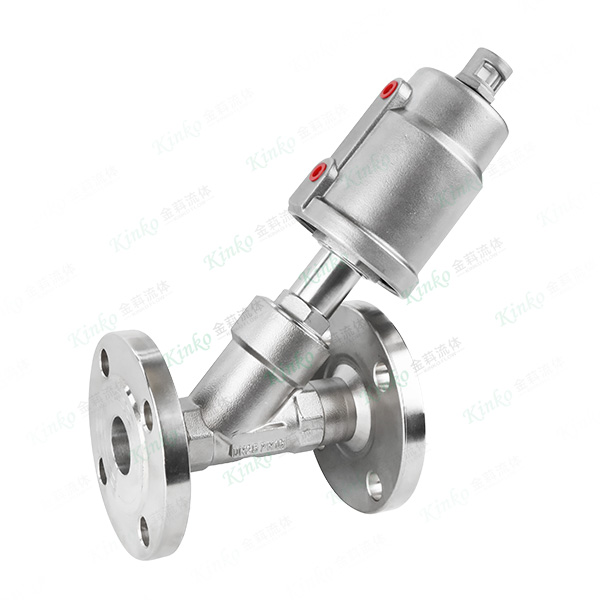
Leakage Rate Standards for Angle Seat Valves
| Standard | Class | Maximum Leakage | Angle Seat Valve Performance |
|---|---|---|---|
| ANSI/FCI 70-2 | Class IV | 1 drop per minute per inch of port size | Exceeds (not typical) |
| ANSI/FCI 70-2 | Class V | 5 x 10⁻¹² m³/sec per mm port size | Exceeds (special seals) |
| ANSI/FCI 70-2 | Class VI (bubble tight) | Zero visible bubbles | Standard with PTFE disc |
| ISO 5208 | Rate A | Zero visible leakage | Standard |
| API 598 | Table 1 | Zero visible leakage | Standard |
Conclusion: A properly installed angle seat valve with a PTFE disc achieves zero visible leakage (Class VI) for the life of the seal.
Installation Practices That Prevent Leakage
Correct Flow Direction
Install with arrow pointing downstream
Pressure above seat (not below)
Test: Valve should close against pressure, not with pressure
Proper Torque for Union Nut
| Valve Size | Recommended Torque (Nm) |
|---|---|
| DN10 – DN25 (3/8" – 1") | 30 – 40 Nm |
| DN32 – DN50 (1-1/4" – 2") | 50 – 70 Nm |
| DN65 – DN100 (2-1/2" – 4") | 80 – 100 Nm |
Warning: Overtightening cracks the actuator housing. Undertightening causes external leakage.
Pipe Alignment
Misaligned pipes stress the valve body
Stressed bodies distort the seat sealing surface
Distorted seats cause internal leakage
Solution: Support heavy pipes, use flexible couplings if needed
Clean Piping Before Installation
Debris is the #1 cause of internal leakage
Weld slag, PTFE tape fragments, and rust all prevent sealing
Flush lines or install Y-strainer (40 mesh)
Maintenance Practices to Prevent Leakage
Daily Visual Inspection
Check weep hole for drips
Observe position indicator (full stroke = full seal)
Listen for hissing (pilot air or media leakage)
Monthly Checks
Tighten pneumatic fittings
Inspect silencer for clogs (clogged silencer prevents full stroke)
Test manual override (should move smoothly)
Seal Replacement Schedule
| Application | PTFE Seal Replacement | Elastomer Seal Replacement |
|---|---|---|
| Clean media, low cycles | Every 2 million cycles or 3 years | Every 1 million cycles or 2 years |
| Steam service | Every 1 million cycles or 2 years | Not applicable (PTFE only) |
| Abrasive media | Every 500,000 cycles | Every 300,000 cycles |
| Aggressive chemicals | Every 1 million cycles | Every 500,000 cycles |
Note: In-line seal replacement takes 10–15 minutes with basic hand tools.
Leakage Comparison: Angle Seat vs Other Valve Types
| Valve Type | Internal Leakage Rate (New) | Leakage After 500k Cycles | External Leak Points |
|---|---|---|---|
| Angle Seat Valve | Class VI (bubble tight) | Class VI (replace seal) | 1 (stem seal + weep hole) |
| Ball Valve | Class VI | Class III – IV (seat wear) | 2 (stem + body seals) |
| Butterfly Valve | Class III – IV | Class II – III (disc wear) | 1 (stem seal) |
| Globe Valve | Class IV – V | Class III – IV (packing wear) | 1 (packing gland) |
Key takeaway: Only angle seat valves maintain Class VI leakage performance after seal replacement without removing the valve from the line.
Troubleshooting Leakage Problems
| Symptom | Likely Cause | Solution |
|---|---|---|
| Drip from weep hole | Worn stem seal | Replace stem O-rings (30 minutes) |
| Visible bubbles across seat | Damaged PTFE disc | Replace disc seal (15 minutes) |
| Media leaks from actuator | Catastrophic stem seal failure | Replace actuator and inspect body |
| Valve passes pressure but pilot works | Debris on seat | Cycle valve 5-10 times to clear, or disassemble |
| Leak stops when pressure increases | Flow direction backward | Reverse valve orientation |
| Intermittent leakage | Pipe stress distorting body | Realign piping, replace body if warped |
Kinko Leakage Prevention Features
Kinko pneumatic angle seat valves include these standard features:
PTFE disc with self-lapping design – Class VI shut-off guaranteed
Double O-ring stem seals – Redundant protection against external leakage
Visible weep hole – Early warning of seal wear
316L stainless steel body – Corrosion resistance prevents body leaks
Bubble-tested at 16 bar – 100% factory tested before shipment
Full seal kit available – OEM-grade replacement seals in stock
Ivan (Mobile:+86-18968769287)
WhatsApp:+86-13579991606
Wechat:+86-18968769287
Website:www.kinko-flow.com
ZHEJIANG KINKO FLUID EQUIPMENT CO.,LTD

 info@kinko-flow.com
 +86-133 5611 9006