Tel:
Tel: E-Mail:
 English
 Chinese
 한국어
한국어
 Español




News
Why Angle Seat Valves Suit Food & Beverage Applications
| Requirement | How Angle Seat Valve Meets It |
|---|---|
| Hygienic design | Angled body prevents dead legs and product buildup |
| Frequent cleaning | Handles CIP (Clean-in-Place) and SIP (Sterilize-in-Place) |
| High cycling | 2–5 million cycles for automated production lines |
| Steam resistance | PTFE seals rated for 180°C / 356°F |
| Corrosion resistance | 316L stainless steel body resists acidic and salty media |
| Self-draining | No standing liquid when line is empty |
Key Applications in Food & Beverage
1. CIP (Clean-in-Place) Systems
CIP systems circulate cleaning solutions (caustic, acid, hot water) through processing equipment without disassembly.
Valve role: Divert cleaning fluids between tanks, pipes, and return lines.
Why angle seat valve: Handles aggressive chemicals at high temperatures. Quick actuation for precise timing. Self-draining prevents dilution of cleaning solutions.
2. Steam Injection & Sterilization
Many food products require direct steam injection for cooking or sterilization.
Valve role: Control steam flow into mixing chambers or jacketed vessels.
Why angle seat valve: PTFE seals withstand 180°C steam. Stainless steel body resists thermal shock. Bubble-tight shut-off prevents product contamination.
3. Filling Machines (Liquid & Viscous Products)
Beverage, dairy, sauce, and oil filling lines require fast, precise on/off control.
Valve role: Start/stop product flow into bottles, pouches, or containers.
Why angle seat valve: Fast response (20–50ms) for high-speed filling. Handles viscous media like yogurt, ketchup, and juice concentrates. High cycle life for 24/7 production.
4. Dairy Processing (Milk, Cream, Yogurt)
Dairy lines involve multiple temperature zones and frequent product changes.
Valve role: Direct raw milk, pasteurized product, and cultured dairy between tanks and separators.
Why angle seat valve: Smooth flow path prevents fat buildup. Self-draining design meets 3A sanitary standards. Easy disassembly for inspection.
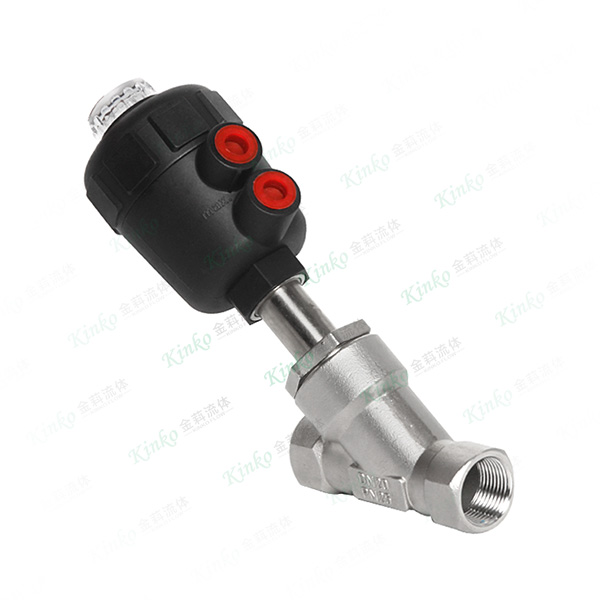
5. Breweries & Beverage Production
Beer, wine, soft drinks, and spirits all require contamination-free transfer.
Valve role: Control flow of wort, beer, wine, or syrup between fermentation tanks, bright beer tanks, and bottling lines.
Why angle seat valve: No crevices for bacteria growth. Compatible with CO2 and inert gas purging. High reliability for long fermentation cycles.
6. Edible Oil & Fat Processing
Oils, margarine, and shortening are viscous and prone to residue buildup.
Valve role: Divert hot oil through filters, heat exchangers, and storage tanks.
Why angle seat valve: Self-cleaning piston action prevents sticking. Handles viscosities up to 600 cSt. High temperature capability for hot oil lines.
7. Soup, Sauce & Gravy Production
These products contain particulates (vegetables, meat pieces) and thickeners.
Valve role: Transfer product from kettles to fillers without clogging.
Why angle seat valve: Angled body allows particles up to 3mm to pass. No cavity for debris to collect. Quick disassembly for cleaning.
8. Sugar & Sweetener Processing
Sugar syrups, honey, and glucose are sticky and crystallize easily.
Valve role: Control flow of hot syrup through evaporators and crystallizers.
Why angle seat valve: PTFE disc prevents sticking. Steam tracing compatible (external insulation available). Reliable operation even with crystal formation.
Material Requirements for Food & Beverage
| Component | F&B Requirement | Kinko Standard |
|---|---|---|
| Valve body | 316L stainless steel (acid/salt resistant) | CF8M / 316L |
| Internal surface finish | Ra ≤ 0.8µm (no bacteria traps) | Electro-polished optional |
| Seal material | FDA-approved PTFE or FKM | PTFE (FDA 21 CFR 177.1550) |
| Actuator housing | Washdown compatible (IP65/IP67) | IP65 with anodized aluminum |
| Connections | Clamp (Tri-clamp) or threaded sanitary | Clamp, BSP, NPT available |
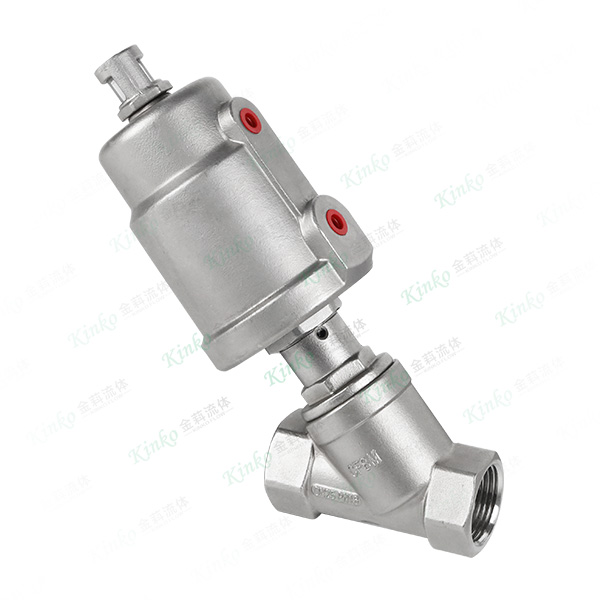
Sanitary Design Features to Look For
When sourcing angle seat valves for food & beverage, verify these features:
Self-draining body: Valve must empty completely when line pressure drops. No standing liquid pockets.
No dead legs: Internal geometry should have no recesses where product can stagnate.
Easy disassembly: Seal changes should require no special tools. Tool-less clamp designs preferred.
Visual position indicator: Yellow/green indicator shows open/closed status for safety checks.
External leak detection: Weep hole warns of seal failure before product contamination occurs.
Comparison: Angle Seat Valve vs Other Valve Types in F&B
| Valve Type | Sanitary Rating | Cycle Life | CIP Compatible | Viscous Media | Cost |
|---|---|---|---|---|---|
| Angle Seat Valve | High | 2–5 million | Yes | Excellent | Moderate |
| Ball Valve | Medium | 50k–200k | Limited | Poor (cavity fills) | Low |
| Butterfly Valve | High | 200k–500k | Yes | Good | Moderate |
| Diaphragm Valve | Highest | 100k–300k | Yes | Excellent | High |
Conclusion: Angle seat valves offer the best balance of cost, cycle life, and viscous media handling for most F&B applications.
Typical Installation Points in a Food Processing Line
Receiving Tank → [Angle Seat Valve] → Heat Exchanger → [Angle Seat Valve] →
Holding Tube → [Angle Seat Valve] → Filler → [Angle Seat Valve] → Packaging
CIP return lines also use angle seat valves to divert cleaning solutions back to the CIP skid.
Maintenance Tips for F&B Environments
Daily: Visual check of position indicator. Listen for unusual noise during actuation.
Weekly: Inspect pneumatic fittings for air leaks. Check weep hole for signs of seal wear.
Monthly: Actuate valve manually to confirm full stroke. Clean actuator exterior during washdown.
Quarterly: Replace PTFE seal if cycle count exceeds 500,000. Lubricate piston if required by media.
Annually: Full disassembly inspection. Replace actuator seals and pilot solenoid if needed.
Common Mistakes to Avoid
Using brass bodies: Brass corrodes in acidic foods (tomato sauce, citrus, vinegar) and fails CIP chemicals. Always use 316L stainless steel.
Ignoring water hammer: Fast closing against high flow rates damages seals. Install flow control (speed controller) on actuator exhaust port.
Inverted mounting: Installing actuator facing down allows product drips to enter cylinder. Mount actuator upward or horizontal only.
Mixing lubricated and dry air: Switching between lubed and dry air washes out factory grease. Pick one method and stay consistent.
Regulatory Compliance for F&B Valves
Ensure your angle seat valves meet these standards:
| Standard | Requirement |
|---|---|
| FDA 21 CFR 177.1550 | PTFE seal material approval |
| EC 1935/2004 | Food contact material (Europe) |
| 3A Sanitary Standard | Cleanability and design (dairy) |
| ATEX | Optional for explosive dust environments (flour, sugar) |
| IP65/IP67 | Washdown protection for actuator |
Why Kinko for Food & Beverage Angle Seat Valves
Kinko manufactures 316L stainless steel pneumatic angle seat valves specifically for sanitary applications:
FDA-approved PTFE seals standard
Tri-clamp (sanitary clamp) connections available
Electro-polished internals option for Ra ≤ 0.8µm finish
IP67 actuator for high-pressure washdown
2–5 million cycle guaranteed service life
Fast delivery for OEM and distributor orders
Ivan (Mobile:+86-18968769287)
WhatsApp:+86-13579991606
Wechat:+86-18968769287
Website:www.kinko-flow.com
ZHEJIANG KINKO FLUID EQUIPMENT CO.,LTD

 info@kinko-flow.com
 +86-133 5611 9006