Tel:
Tel: E-Mail:
 English
 Chinese
 한국어
한국어
 Español




News
This guide provides a technical framework for B2B procurement engineers and plant managers to select the ideal butterfly valve actuator for your specific application.
Part 1: Three Primary Actuator Types
Before diving into torque calculations, understand the core differences.
| Actuator Type | Power Source | Best For | Key Advantage | Key Limitation |
|---|---|---|---|---|
| Pneumatic | Compressed air (3-8 bar) | Fast cycling, explosion-proof areas | High speed, low cost, intrinsically safe | Requires air compressor, noisy |
| Electric | 12/24V DC, 110/220V AC | Remote monitoring, precise positioning | Programmable, data feedback, clean | Slower response, vulnerable to power loss |
| Hydraulic | Hydraulic oil (100-350 bar) | High torque, heavy-duty continuous operation | Massive torque output, stable | Expensive, leak risks, high maintenance |
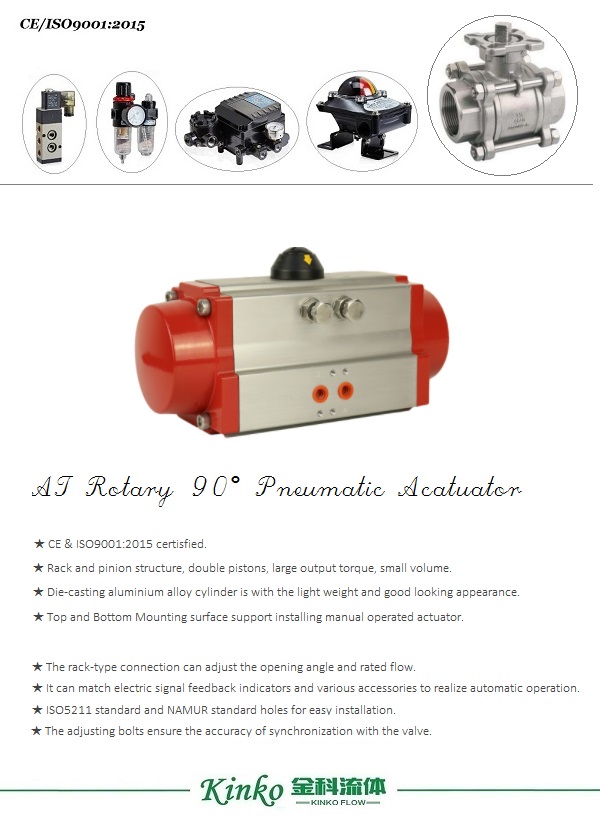
Pneumatic Actuators: Kinko AT and AW Series
Kinko offers two primary pneumatic actuator series engineered for butterfly valve automation.
Kinko AT Series (Rack and Pinion)
Torque range: 8 Nm to 4,000 Nm
Best for: Small to medium butterfly valves (2” to 12”), high cycle applications
Features: Compact design, linear torque output, ISO 5211 mounting
Action available: Double-acting and spring-return (fail-safe close/open)
Kinko AW Series (Scotch Yoke)
Torque range: 200 Nm to 25,000 Nm
Best for: Large butterfly valves (12” to 40”), high differential pressure
Features: High break torque, rugged construction, long stroke life
Action available: Double-acting and spring-return
Both series feature ISO 5211 standard mounting pads for direct bolt-on to Kinko wafer and lug butterfly valves. For explosive environments, ATEX-certified options are available for both AT and AW series.
Electric Actuators (Quarter-turn)
Best for: Water treatment plants, HVAC, remote pipelines.
Control: On/off (non-modulating) or modulating (4-20mA signal).
Kinko Note: Kinko electric actuators include manual override handwheels and visual position indicators.
Hydraulic Actuators
Best for: Large-diameter valves (24”+), subsea, or high-pressure slurry.
Caution: Requires hydraulic power unit (HPU).
Part 2: The Critical Selection Matrix (B2B Buyers Must Read)
Do not buy an actuator based on valve size alone. Use this four-step filter.
Step 1: Calculate Required Torque (Break to Seat)
Butterfly valve torque varies by:
Valve type: Concentric (lowest), double-offset, triple-offset (highest).
Seal material: EPDM (low), PTFE (medium), Metal (high).
Pressure differential: Higher ΔP = higher torque.
Formula: Actuator torque = (Valve seat torque + Safety factor) x 1.3
| Valve Size (Inch) | Pressure Rating (PN) | Min Torque Required (Nm) – EPDM | Min Torque Required (Nm) – PTFE | Recommended Kinko Actuator |
|---|---|---|---|---|
| 2” (DN50) | PN16 | 15 Nm | 25 Nm | AT-52 |
| 4” (DN100) | PN16 | 40 Nm | 65 Nm | AT-83 |
| 6” (DN150) | PN16 | 80 Nm | 130 Nm | AT-105 |
| 8” (DN200) | PN10 | 150 Nm | 220 Nm | AT-145 or AW-13 |
| 12” (DN300) | PN10 | 300 Nm | 450 Nm | AW-17 |
| 16” (DN400) | PN10 | 600 Nm | 850 Nm | AW-20 |
| 20” (DN500) | PN6 | 1,200 Nm | 1,800 Nm | AW-25 |
Kinko Pro Tip: Always add a 30% safety margin. Torque values above are for clean water. Slurries or dry powders require 50-100% additional torque. For high-cycle applications (over 100 cycles per hour), select the AT series rack and pinion actuator.
Step 2: Match Mounting Interface (ISO 5211)
All Kinko butterfly valves and actuators comply with ISO 5211 standard mounting flanges. Verify these dimensions before purchase:
| Actuator Size (Fxx) | Flange Pattern (mm) | Square Drive (mm) | Compatible Valve Size (Kinko Series) | Compatible Kinko Actuator |
|---|---|---|---|---|
| F03 | 36 x 42 | 9 mm | DN40 – DN50 (1.5” – 2”) | AT-32 |
| F05 | 50 x 70 | 11 or 14 mm | DN65 – DN100 (2.5” – 4”) | AT-52, AT-63 |
| F07 | 70 x 90 | 17 mm | DN125 – DN200 (5” – 8”) | AT-83, AT-105, AW-13 |
| F10 | 90 x 125 | 22 mm | DN250 – DN300 (10” – 12”) | AT-145, AW-17 |
| F14 | 130 x 180 | 36 mm | DN350 – DN400 (14” – 16”) | AW-20, AW-25 |
| F16 | 150 x 210 | 46 mm | DN450 – DN500 (18” – 20”) | AW-30, AW-35 |
Step 3: Determine Fail-Safe Position
Spring-return pneumatic (AT-SR or AW-SR series) : Returns to closed or open upon air failure. Specify “fail close” or “fail open” when ordering.
Electric with battery backup: Closes on power failure.
Double-acting pneumatic (AT-DA or AW-DA) : Holds last position upon air failure.
Hydraulic: Typically holds position unless a spring or accumulator is added.
Step 4: Environmental and Control Conditions
Temperature: Standard actuators: -20°C to +80°C. High-temp options for AT/AW series: up to +150°C with special seals.
Ingress Protection (IP) : Indoor: IP54. Outdoor or flood-prone: IP67 or IP68 (available for Kinko electric series).
Control signal options:
On/Off: Limit switches (pneumatic or electric)
Modulation: 4-20mA input and output (electric actuators, or pneumatic with positioner)
Bus communication: Modbus, Profibus, Foundation Fieldbus (electric actuators)
Part 3: Application-Specific Recommendations (Kinko Product Line)
Based on real B2B installations, here is the optimal actuator type for common industries:
| Industry | Valve Media | Recommended Actuator | Kinko Model Example | Key Feature Required |
|---|---|---|---|---|
| Municipal Water | Clean water | Electric (Modulating) | Kinko Electric Series | 4-20mA feedback, IP67 |
| Wastewater | Sludge | Pneumatic (Double-acting) | Kinko AT-DA series | High cycle life, corrosion coating |
| Chemical Dosing | Acids | Pneumatic (Explosion-proof) | Kinko AT-SR with ATEX | ATEX or IECEx certified |
| HVAC | Chilled water | Electric (On/Off) | Kinko Mini Electric | Compact size, 24V AC |
| Oil and Gas | Crude oil | Pneumatic Scotch yoke | Kinko AW-SR series | High break torque, fail-safe close |
| Food and Beverage | CIP fluids | Pneumatic (Stainless steel) | Kinko AT-SS series | Washdown duty, FDA seals |
| Power Generation | Cooling water | Pneumatic Scotch yoke | Kinko AW-DA series | Large bore, high cycle life |
| Mining | Slurry | Hydraulic or AW series | Kinko AW-25 | Massive torque, abrasion resistance |
Part 4: Pneumatic Actuator Selection – AT vs AW Series
For buyers specifically evaluating Kinko pneumatic actuators, use this direct comparison:
| Selection Factor | Kinko AT Series (Rack and Pinion) | Kinko AW Series (Scotch Yoke) |
|---|---|---|
| Torque output profile | Linear (constant throughout stroke) | Progressive (high break, lower seat) |
| Torque range | 8 Nm to 4,000 Nm | 200 Nm to 25,000 Nm |
| Ideal valve size | DN50 to DN300 (2” to 12”) | DN200 to DN1000 (8” to 40”) |
| Cycle speed | Very fast (0.3 sec typical) | Moderate (1-3 sec typical) |
| Air consumption | Low | Moderate to high |
| Best application | High cycling, modulating service | Large valves, high differential pressure |
| Price point | Lower cost per torque | Higher cost, longer life |
| Fail-safe option | Spring-return available (AT-SR) | Spring-return available (AW-SR) |
Selection rule: Choose AT series for speed and cycle life on valves up to 12 inches. Choose AW series for raw torque and reliability on valves 12 inches and larger, or when media creates high break torque.
Part 5: Common Mistakes in Actuator Selection
Avoid these costly procurement errors:
Under-sizing torque: A 4” PTFE-lined valve needs nearly double the torque of an EPDM valve. Use the torque table in Part 2. Always oversize by 30%.
Ignoring cycle frequency: Electric actuators overheat if cycled more than 60 times per hour. Use Kinko AT pneumatic series for high cycling (up to 500 cycles per hour).
Mixing mounting interfaces: An F10 actuator will not bolt to an F07 valve. Always match ISO 5211 patterns. Kinko provides adapter brackets for non-standard combinations.
Forgetting manual override: In power loss scenarios, a handwheel on an electric actuator is mandatory for maintenance. Pneumatic AT and AW series can be manually overridden with a hex key or optional handwheel.
Ignoring air quality: For pneumatic AT and AW actuators, use clean, dry, lubricated air (40 micron filtration minimum). Dirty air destroys internal seals within months.
Wrong fail-safe direction: Specify fail close (spring returns to closed) or fail open (spring returns to open) at time of order. This cannot be changed in the field on spring-return models.
Part 6: Quick Selection Checklist for Procurement
Use this checklist when contacting Kinko sales or issuing a purchase order:
Valve size and type (example: 6” Kinko wafer butterfly, PTFE seat)
Required torque (Nm or lb-in) with media description (water, slurry, gas, powder)
Power source available:
Pneumatic: Air pressure (PSI or bar) and quality
Electric: Voltage (24V DC, 110V AC, 220V AC)
Hydraulic: Pressure and flow rate
Actuator action:
Pneumatic: Double-acting (Kinko AT-DA or AW-DA) or Spring-return (Kinko AT-SR or AW-SR)
Electric: On-off or modulating (4-20mA)
Fail-safe requirement (Close / Open / Stay-put)
Environmental rating (IP67 / IP68 / Explosion-proof Zone 1 or 2 / ATEX)
Communication protocol (None / 4-20mA / Modbus / Profibus)
Ambient temperature range (standard -20°C to +80°C or high-temp option)
Required accessories (limit switch box, solenoid valve, positioner, handwheel)
Conclusion and Next Steps
Selecting the correct butterfly valve actuator is a technical balance of torque, mounting, environment, and control logic.
For standard applications up to 12 inches, Kinko AT series pneumatic actuators offer speed, cycle life, and low cost.
For large valves or high differential pressure, Kinko AW series scotch yoke actuators provide the necessary break torque and rugged reliability.
For remote monitoring and precise control, Kinko electric actuators deliver programmability and data visibility.
Kinko manufactures a complete line of ISO 5211-compliant pneumatic actuators (AT and AW series) and electric actuators engineered specifically for butterfly valves. All actuators undergo 100% torque testing and pressure testing before shipment.
For a detailed torque calculation sheet or a custom actuator quotation, contact the Kinko engineering team with your valve size, media, and pressure specifications.
Ivan (Mobile:+86-18968769287)
WhatsApp:+86-13579991606
Wechat:+86-18968769287
Website: www.kinko-flow.com
ZHEJIANG KINKO FLUID EQUIPMENT CO.,LTD

 info@kinko-flow.com
 +86-133 5611 9006